
For brokers, introducers and consultants
Put both sides in one conversation. Without handing over their telephone numbers.
You made the introduction. You should still be there for the deal that follows it — and for the ones after that. DealRoom gives buyer and seller a shared room they can actually work in, with aliases instead of contact details and no private channel to slip into.
The moment it goes wrong
It takes about fifteen seconds, and you are usually the one who does it.
You have spent weeks finding the right buyer. The seller is finally comfortable. Everyone wants to move, so you do the sensible, obliging thing and set up a group so the three of you can get on with it.
The second the last person joins, every telephone number in that group is visible to everyone else. Not shared deliberately. Just published, as a side effect of the tool. And now the two people whose relationship you built, and whose introduction you own, have each other saved in their phones.
Nothing happens for a fortnight. Then the replies get shorter, the questions stop coming to you, and somewhere around the fourth week you find out the deal completed.
The real cost
You did not lose a commission. You lost a client relationship and everything that came with it.
One-off fees are how the loss gets described. It is not how it is felt. Here is what actually goes.
This introduction
The obvious one, and the one people fixate on. The fee you were owed for putting two parties in a room together, gone because the room stopped being yours the moment everyone's number was published in it.
The repeat instructions
The seller who was going to come back to you when the next site, business or block came up. They do not need you now. They have a buyer in their phone.
The referral chain
Neither party will recommend you to anyone, because from their side you were an introduction they made once and then stopped needing. Your best marketing is people saying your name in rooms you are not in.
The reputation
Being the person who brings deals is worth more than any single commission. It is also the thing that quietly erodes when the market learns you can be stepped around.
This is the part that stings, and it is why intermediaries end up being cautious in a way that slows deals down. The fee was never the point. The point was being the person both sides come back to.
Why the usual options both fail
Keep them apart and you stall the deal. Put them together and you hand over the relationship.
Option one
You sit in the middle and relay everything
Every question goes through you. Every answer comes back through you. It protects the introduction and it works right up until the buyer's solicitor asks something technical on a Friday afternoon. Then you are the reason the deal is waiting, and both parties start wondering whether it would be quicker to talk directly. Which, eventually, is exactly what they do.
Option two
You open a group chat and hope for the best
The deal moves properly. Everyone can ask, answer and share. You also gave away the one thing you were being paid for, on day one, permanently, in a tool that has no concept of a transaction and keeps no record you could ever rely on.
Both options are bad because the tools were never built for a deal with three or four sides and different things each of them is allowed to see. That is the false choice DealRoom is meant to break.
A non-circumvention agreement is a remedy, not a defence.
Keep the agreement. Have it drafted properly. But be honest about what it does: it gives you something to argue in a dispute you have already lost the deal in. Enforcing it costs money, takes months, and finishes off whatever was left of the relationship with both parties.
What you actually want is for the easy route around you not to exist in the first place.
DealRoom does not replace your agreement and does not pretend to. It holds it as an access gate, so the signature is in place before anyone reaches the confidential material, and the room records when that happened.
What changes
A room built for a deal with sides, not a chat thread with everyone's number in it.
Aliases you set, not telephone numbers
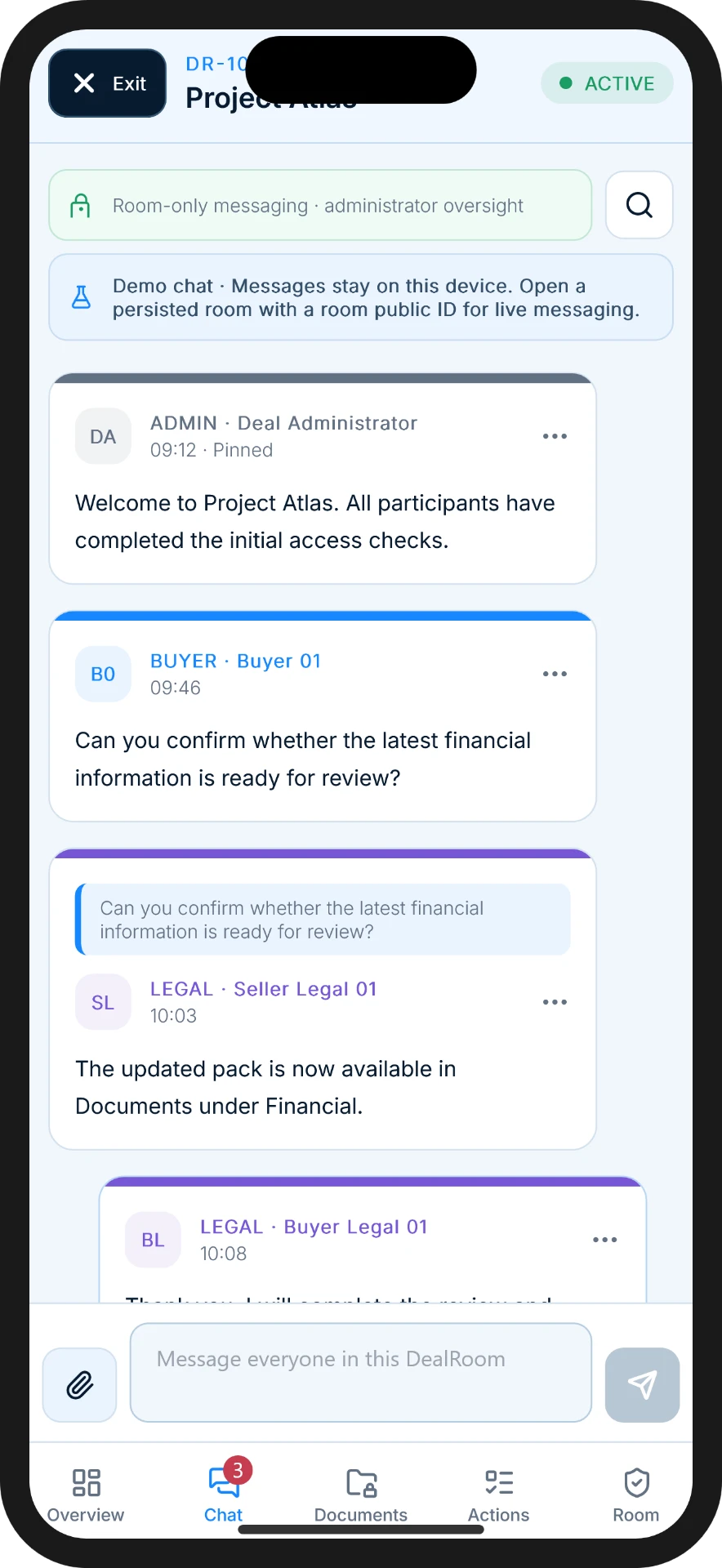
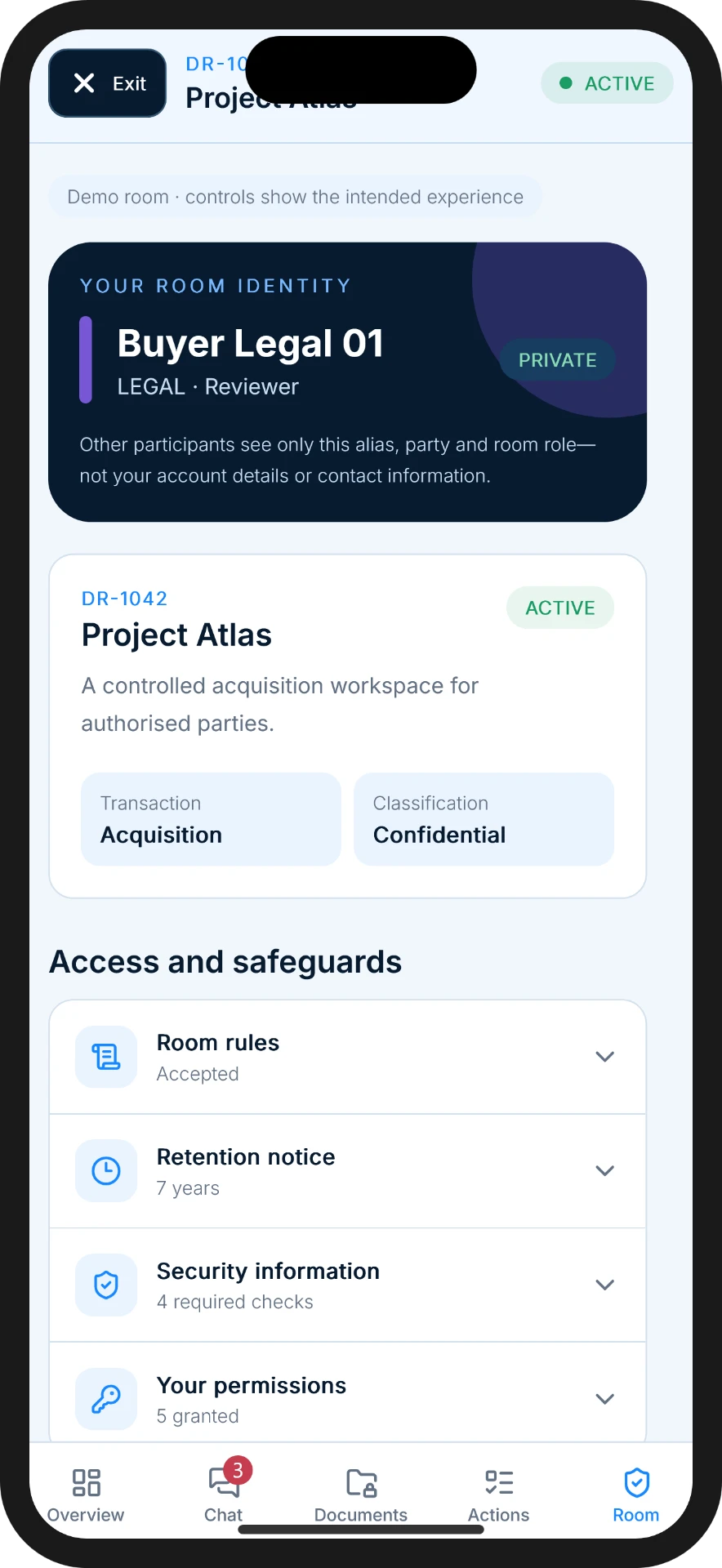
Aliases are yours to set. As administrator you name each participant to suit the deal, with colours and a custom tag showing which side someone sits on, so the room reads clearly without a single telephone number or email address changing hands.
Contact details are blocked as they are typed
If someone starts typing a telephone number or email address into a message, DealRoom warns them and will not let the message send. Nothing arrives in the room, and you can override the control yourself if a particular deal needs details exchanged.
No private messaging inside the room
There is no direct-message function between participants and no user search. If it needs saying, it gets said where you can see it.
The agreement comes before the detail
Gate confidential access behind the NDA or non-circumvention agreement. Nobody reaches the numbers until the signature is in place.
Documents by permission
Set visibility by room, by party or by individual participant. The seller's accounts go to the buyer's adviser without being broadcast to everyone in the room.
One record of the whole thing
Messages, documents, signatures and required actions sit in one auditable history. If the deal is ever disputed, the sequence is not a matter of memory.
Contact-detail screening
The room is built to keep private contact details out of it, rather than to publish them by default the second somebody joins.
The deal after this one
The room is yours, and so is every deal that runs through it.
Circumvention is not really a one-off risk. It is a recurring one, because every introduction you make is another chance for two parties to decide they no longer need you.
As the administrator you create the room, invite the parties, set the aliases and decide who can see which documents. That role does not fade into the background once the conversation gets going — it is visible in every announcement, every access decision and every required action on the list.
It also means no one is out of reach. Where a party won't circulate an email address — a high-profile principal, a diplomatic or government counterparty, anyone whose contact details are sensitive in themselves — you can issue a unique join code instead. They enter the room on your terms, under the alias you've set, without an address changing hands.
Which means the next time either party has a transaction, the process they remember running smoothly is the one you administered. Your value stops being an introduction they made once and becomes the way their deals get done.
Being straight with you
What DealRoom cannot do.
No software can stop two people who are determined to find each other from doing so. If a buyer knows the company name, they can find a switchboard number. DealRoom does not claim otherwise, and you should be sceptical of anything that does.
What it removes is the obvious route: the published telephone number, the private message, the side thread nobody sees. What it adds is a record — of who was in the room, what was agreed, when the agreement was signed and what was shared under it.
Harder to step around, and far easier to evidence if somebody tries. That is the honest claim.
Side by side
What you give up with a consumer group chat, and what a data room never gave you.
Data rooms handle documents and ignore the conversation. Messaging apps handle the conversation and publish everyone's details. The gap between the two is where introductions get lost.
| Capability | Typical consumer messaging | Typical document-first data room | DealRoom |
|---|---|---|---|
| Real-time shared discussion | Yes | Varies by provider | Yes |
| Private contact details hidden | No | Varies by provider | Yes |
| No participant-to-participant DMs | No | Varies by provider | Yes |
| Room-specific aliases | No | Varies by provider | Yes |
| Colour-coded parties | No | Varies by provider | Yes |
| NDA-gated access | No | Varies by provider | Yes |
| Controlled documents | No | Yes | Yes |
| Required actions | No | Varies by provider | Yes |
| Administrator oversight | Varies by provider | Varies by provider | Yes |
| One connected audit trail | No | Varies by provider | Yes |
| Built for intermediary-led introductions | No | No | Yes |
Real-time shared discussion
- Typical consumer messaging
- Yes
- Typical document-first data room
- Varies by provider
- DealRoom
- Yes
Private contact details hidden
- Typical consumer messaging
- No
- Typical document-first data room
- Varies by provider
- DealRoom
- Yes
No participant-to-participant DMs
- Typical consumer messaging
- No
- Typical document-first data room
- Varies by provider
- DealRoom
- Yes
Room-specific aliases
- Typical consumer messaging
- No
- Typical document-first data room
- Varies by provider
- DealRoom
- Yes
Colour-coded parties
- Typical consumer messaging
- No
- Typical document-first data room
- Varies by provider
- DealRoom
- Yes
NDA-gated access
- Typical consumer messaging
- No
- Typical document-first data room
- Varies by provider
- DealRoom
- Yes
Controlled documents
- Typical consumer messaging
- No
- Typical document-first data room
- Yes
- DealRoom
- Yes
Required actions
- Typical consumer messaging
- No
- Typical document-first data room
- Varies by provider
- DealRoom
- Yes
Administrator oversight
- Typical consumer messaging
- Varies by provider
- Typical document-first data room
- Varies by provider
- DealRoom
- Yes
One connected audit trail
- Typical consumer messaging
- No
- Typical document-first data room
- Varies by provider
- DealRoom
- Yes
Built for intermediary-led introductions
- Typical consumer messaging
- No
- Typical document-first data room
- No
- DealRoom
- Yes
Straight answers
The questions intermediaries actually ask.
Your sector
Which kind of intermediary are you?
The problem is the same everywhere. The detail is not — the parties, the documents and the point at which it goes wrong all differ by sector.
DealRoom provides communication and transaction-workflow technology. It does not replace properly drafted legal agreements or professional legal advice, and no platform can guarantee that parties will never communicate outside it.
Open the conversation. Keep control of the introduction.
Bring every authorised party into one professional transaction environment without exposing private contact details or creating hidden in-app side channels.
Submitting this form does not create a DealRoom account. Accounts are created securely inside the mobile app.